







A Note Before We Begin: Understanding calories is not about obsession or restriction. It is about empowerment—knowing how your body uses energy so you can make informed choices. This guide draws from reputable medical sources. It is not a substitute for professional medical advice. Please consult your healthcare provider before making significant changes to your diet, especially if you have underlying health conditions.
Introduction: The Simple Truth Behind Weight Loss
Every diet you have ever heard of—keto, intermittent fasting, paleo, Weight Watchers, the Mediterranean diet—works for one reason: they help you eat fewer calories than your body burns.
That is it. That is the secret hiding in plain sight.
A calorie deficit is not a fad. It is not a gimmick. It is the biological mechanism that governs weight loss, confirmed by decades of nutritional science and endorsed by organizations like the CDC, the NHS, and the National Institutes of Health.
But here is what those organizations also know: understanding the deficit is easy. Living in one is harder. Hunger, stress, sleep, hormones, and the relentless presence of ultra-processed food all conspire against your best intentions.
This guide will walk you through what a calorie deficit is, how it works, how to create one safely, and how to sustain it without misery. No shame. No extremes. Just clarity.
1. What Exactly Is a Calorie?
Before we talk about deficits, let us define the unit itself.
A calorie is a measure of energy. Specifically, it is the amount of energy required to raise the temperature of one kilogram of water by one degree Celsius. In nutrition, when we say “calorie,” we actually mean kilocalorie—1,000 of those tiny units.
Your body runs on calories the way a car runs on fuel. You take them in through food and drink. You burn them through:
- Basal Metabolic Rate (BMR): The energy your body uses just to stay alive—breathing, circulating blood, regulating temperature. This accounts for 60–70% of your daily burn.
- Physical Activity: Everything from walking to the mailbox to running a marathon.
- Thermic Effect of Food (TEF): The energy required to digest, absorb, and process the food you eat. This accounts for about 10% of your daily burn.
Understanding these three components is essential because they determine your Total Daily Energy Expenditure (TDEE) —the total number of calories you burn each day.
| Component | What It Means | % of Daily Burn |
|---|---|---|
| Basal Metabolic Rate (BMR) | Energy for basic life functions at rest | 60–70% |
| Physical Activity | Movement, exercise, daily tasks | 20–30% |
| Thermic Effect of Food (TEF) | Energy to digest and process food | ~10% |
2. The Deficit Defined: When You Burn More Than You Eat
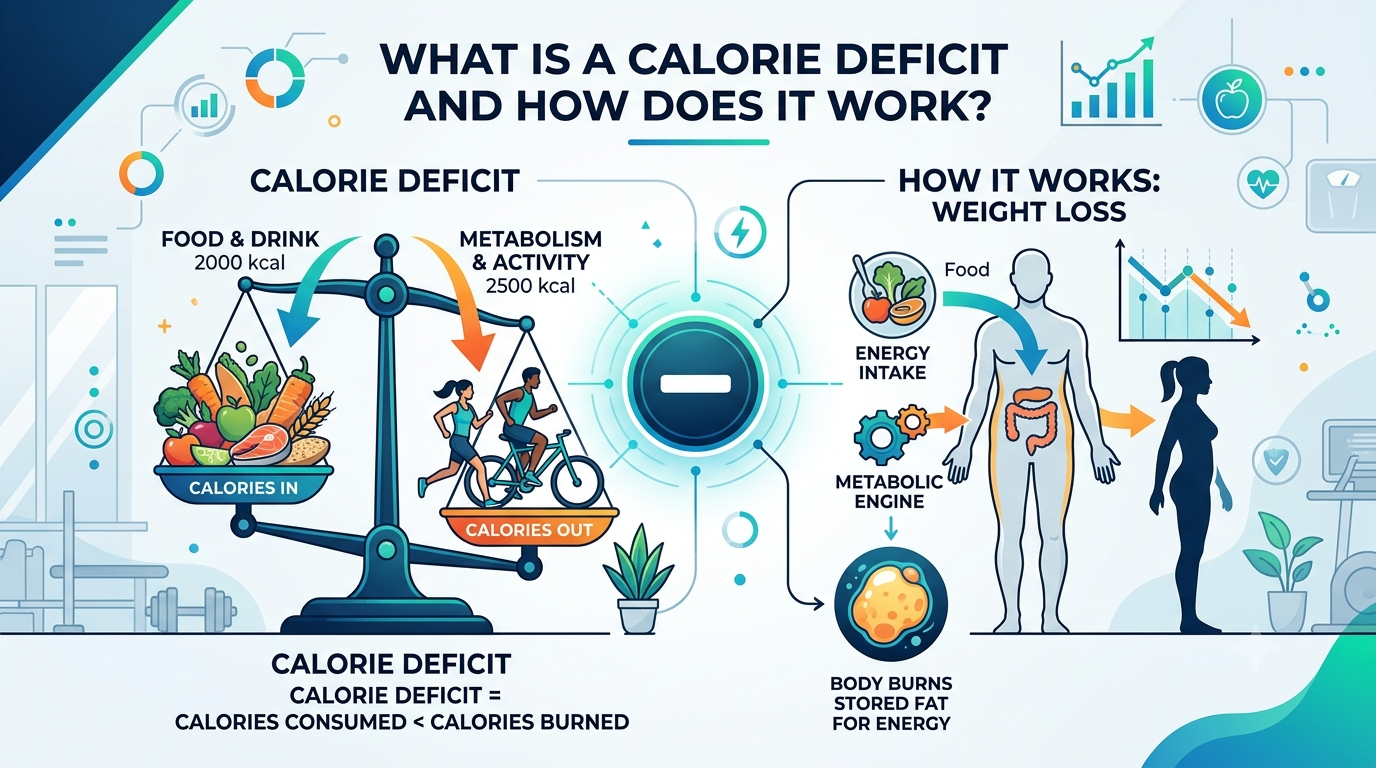
A calorie deficit occurs when the number of calories you consume is less than the number of calories your body burns.
When this happens, your body cannot get enough energy from food. So it turns to its reserves. It breaks down stored fat (and sometimes muscle) to make up the difference. This is not a flaw in your biology—it is a survival mechanism honed over millions of years.
The formula is simple:
Calories In < Calories Out = Calorie Deficit = Weight Loss
Conversely:
Calories In > Calories Out = Calorie Surplus = Weight Gain
Calories In = Calories Out = Maintenance = Weight Stability
The CDC states this plainly: “To lose weight, you need to use more calories than you take in” .
3. The 3,500-Calorie Rule (And Its Limitations)
You have likely heard the number 3,500. It comes from a simple calculation: one pound of body fat contains approximately 3,500 calories.
Therefore, to lose one pound of fat, you need to create a cumulative deficit of 3,500 calories.
Breaking it down by time:
| Timeframe | Daily Deficit Needed | Weekly Weight Loss |
|---|---|---|
| 1 week | 500 calories/day | ~1 pound |
| 2 weeks | 500 calories/day | ~2 pounds |
| 1 month | 500 calories/day | ~4 pounds |
| 6 months | 500 calories/day | ~26 pounds |
This is the math behind the standard recommendation to cut 500 calories per day for steady, sustainable weight loss.
But here is the caveat: The 3,500-calorie rule is a guideline, not a law of physics. It was derived from a 1958 study and does not account for metabolic adaptation, changes in body composition, or individual variation . As you lose weight, your TDEE decreases because a smaller body requires less energy. This means the same 500-calorie deficit that worked at 200 pounds may not work at 180 pounds.
Think of it as a compass, not a GPS. It points you in the right direction, but the path will curve.
4. How to Create a Deficit (Two Levers, One Goal)
There are two ways to create a calorie deficit: eat less or move more. The most effective approach uses both.
Lever One: Reduce Calorie Intake
This is the most direct method. The CDC recommends reducing your daily intake by 500–1,000 calories to lose 1–2 pounds per week . For a 2,000-calorie diet, that means eating between 1,000 and 1,500 calories—a significant but manageable reduction for most people.
Practical ways to cut calories without feeling deprived:
- Swap sugary drinks for water or unsweetened tea
- Use smaller plates to naturally reduce portions
- Fill half your plate with vegetables (high volume, low calories)
- Choose lean proteins over fatty cuts
- Limit fried foods and processed snacks
The American Diabetes Association’s Diabetes Plate Method is a simple visual guide: half non-starchy vegetables, one quarter lean protein, one quarter high-fiber carbohydrates .
Lever Two: Increase Physical Activity
Exercise increases the “calories out” side of the equation. The CDC recommends at least 150 minutes of moderate-intensity activity per week for general health , but you may need more to create a meaningful deficit.
| Activity (30 minutes) | Calories Burned (155-lb person) |
|---|---|
| Walking (3.5 mph) | ~140 |
| Cycling (moderate) | ~260 |
| Swimming (moderate) | ~230 |
| Running (5 mph) | ~300 |
| Strength Training | ~110–160 |
The combined approach: If you cut 300 calories from your diet and burn 200 calories through exercise, you have created a 500-calorie daily deficit—the equivalent of one pound per week—without extreme restriction in either area.
5. The Safety Floor: Never Go Below 1,200 Calories
A calorie deficit is a tool. Like any tool, it can be misused.
The NHS and other health authorities warn against very low-calorie diets (below 1,200 calories for women and 1,500 for men) without medical supervision . Eating too little can lead to:
- Nutritional deficiencies (vitamins, minerals, protein)
- Muscle loss (including heart muscle)
- Gallstones
- Fatigue, dizziness, and irritability
- Metabolic slowdown
- Disordered eating patterns
A safe deficit is one you can sustain. If you are constantly ravenous, exhausted, or obsessed with food, your deficit is too aggressive. Dial it back.
6. Why the Scale Doesn’t Always Cooperate
You are in a deficit. You are doing everything “right.” And yet the scale refuses to move—or worse, it goes up.
This is normal. Here is why:
| Factor | What Happens | Effect on Scale |
|---|---|---|
| Water Retention | Sodium, carbs, hormones, stress | Temporary weight gain |
| Muscle Gain | Strength training builds muscle | Scale may stay same while fat drops |
| Constipation | Less food = less waste | Temporary weight retention |
| Menstrual Cycle | Hormonal water retention | 2–5 lbs fluctuation |
| Metabolic Adaptation | Body becomes more efficient | Deficit needs adjustment |
The scale is one data point. It is not the whole story. Pay attention to how your clothes fit, your energy levels, your strength, and your overall well-being. These are often more reliable indicators of progress than a number on a machine.
7. The Role of Food Quality (Calories Are Not Created Equal)
A calorie is a calorie—in a laboratory. In your body, it is more nuanced.
200 calories of almonds and 200 calories of soda have the same energy content. But they affect your body differently:
- Almonds provide protein, fiber, and healthy fats that keep you full for hours.
- Soda provides quick sugar that spikes insulin, crashes blood sugar, and leaves you hungry again within an hour.
The CDC and NHS both emphasize that nutrition quality matters for sustainable weight loss . A deficit built on nutrient-dense foods is easier to maintain because you feel satisfied. A deficit built on junk food is a recipe for hunger, cravings, and eventual abandonment.
Prioritize:
- Vegetables and fruits
- Lean proteins (chicken, fish, beans, tofu)
- Whole grains (oats, brown rice, quinoa)
- Healthy fats (olive oil, nuts, avocado)
Limit:
- Sugary drinks
- Refined carbohydrates (white bread, pastries)
- Ultra-processed snacks
- Alcohol
8. Common Myths About Calorie Deficits
Myth: “Starvation mode” will stop you from losing weight.
Truth: Your metabolism does slow down when you eat less, but true “starvation mode”—where your body refuses to burn fat—only occurs in cases of severe, prolonged starvation. A moderate deficit will still result in weight loss, though the rate may slow over time .
Myth: You can out-exercise a bad diet.
Truth: It takes about an hour of running to burn off a single slice of cheesecake. Exercise is crucial for health, but it is far easier to cut calories through food than to burn them through activity.
Myth: Eating after 8 PM causes weight gain.
Truth: Weight gain is determined by total daily calories, not the timing of those calories. However, late-night eating often leads to mindless snacking and poorer food choices .
Myth: Carbs make you fat.
Truth: Excess calories make you fat. Carbohydrates are your body’s preferred energy source. The key is choosing complex carbs over simple ones and managing portions .
9. How to Calculate Your Personal Deficit
Step 1: Estimate your TDEE.
Use an online calculator or the Mifflin-St Jeor equation:
- Men: BMR = (10 × weight in kg) + (6.25 × height in cm) − (5 × age in years) + 5
- Women: BMR = (10 × weight in kg) + (6.25 × height in cm) − (5 × age in years) − 161
Then multiply by an activity factor:
| Activity Level | Multiplier |
|---|---|
| Sedentary (little exercise) | 1.2 |
| Lightly active (1–3 days/week) | 1.375 |
| Moderately active (3–5 days/week) | 1.55 |
| Very active (6–7 days/week) | 1.725 |
| Extremely active (physical job + exercise) | 1.9 |
Step 2: Subtract 500 calories.
This creates a ~1 pound per week deficit. Adjust based on your results after 2–3 weeks.
Step 3: Monitor and adjust.
If you are not losing weight after 3 weeks of consistent effort, reduce by another 100–200 calories or increase activity.
Helpful Websites (Fact-Checked and Trustworthy)
A 2024 data-mining study analyzed 432 Google searches for weight loss and identified the most trustworthy non-advertising websites based on accuracy statements, author credentials, and reputation scores . These sites consistently provide evidence-based information:
| Website | Category | Reputation Score | Why It’s Trustworthy |
|---|---|---|---|
| mayoclinic.org | Health | 100/100 | Mayo Clinic Staff authorship, evidence-based |
| healthline.com | Health | 96/100 | Fact-checked, written by healthcare professionals |
| webmd.com | Health | 96/100 | Physician-reviewed content |
| verywellfit.com | Nutrition & Diet | 88/100 | Nutrition-focused, fact-checked |
| womenshealthmag.com | Women’s Health | 88/100 | Author credentials and fact-checking |
Additional government and institutional resources:
- CDC Healthy Weight (cdc.gov/healthy-weight-growth): Practical steps from the Centers for Disease Control
- NHS Weight Loss Guide (nhsinform.scot): Clear, compassionate advice from the UK’s National Health Service
- NIDDK Weight Management (niddk.nih.gov): Evidence-based information from the National Institutes of Health
- USDA MyPlate (myplate.gov): Visual guidance for balanced eating
Caution: Be wary of websites that promise rapid results, sell supplements, or lack author credentials. The study found that “Personal Pages and Blogs” often lack transparency about authorship and accuracy.
Frequently Asked Questions
Q: How many calories should I eat to lose weight?
A: It depends on your age, sex, weight, height, and activity level. Most women should not go below 1,200 calories per day, and most men should not go below 1,500, without medical supervision. A common approach is to calculate your TDEE and subtract 500 calories .
Q: Can I lose weight without counting calories?
A: Yes. Many people lose weight by focusing on food quality, portion sizes, and mindful eating rather than strict tracking. The Diabetes Plate Method, for example, controls portions visually without numbers . However, some people find tracking helpful for awareness.
Q: How long does it take to see results from a calorie deficit?
A: Most people see initial weight loss (largely water weight) within the first week. Fat loss becomes noticeable after 2–4 weeks of consistent effort. Sustainable weight loss is typically 1–2 pounds per week.
Q: Do I need to exercise to lose weight?
A: Not strictly—you can create a deficit through diet alone. However, exercise is crucial for overall health, preserves muscle mass during weight loss, and helps with long-term weight maintenance. The CDC recommends at least 150 minutes of moderate activity per week .
Q: What happens if I eat too few calories?
A: Eating too few calories can lead to muscle loss, nutritional deficiencies, fatigue, gallstones, and metabolic slowdown. It also increases the risk of binge eating and disordered eating patterns. A moderate deficit is safer and more sustainable.
Q: Why am I not losing weight in a calorie deficit?
A: Possible reasons include: inaccurate tracking (portion sizes, oils, drinks), metabolic adaptation (your body needs fewer calories as you lose weight), water retention, muscle gain, or a medical condition such as hypothyroidism. Consult a healthcare provider if you are consistently in a deficit but not seeing results.
A Final Word: The Deficit Is the Beginning, Not the End
A calorie deficit is the mechanism of weight loss. But it is not the whole story of health.
How you create that deficit matters. A deficit built on whole foods, adequate protein, regular movement, quality sleep, and stress management will leave you feeling strong, energized, and capable. A deficit built on starvation, guilt, and obsession will leave you depleted—and likely back where you started.
The NHS offers perhaps the most important reminder: “Be realistic and kind to yourself. Expect ups and downs and remember, everyone has off days. What matters is getting back on track without feeling guilty” .
You do not need to be perfect. You do not need to count every almond. You need to understand the principle, apply it gently, and adjust as you go.
The deficit is the science. How you live it is the art.
Imp. Note: This article is for informational purposes only and does not constitute medical advice. Always consult with a qualified healthcare professional before beginning any weight loss program.