




The science of health is moving faster than most of us can track. Every month brings new studies, new technologies, and new ways of understanding the human body that would have seemed like science fiction a decade ago. Yet beneath the headlines and hype, real patterns are emerging—genuine shifts in how researchers, clinicians, and everyday people are approaching wellness.
This is not a list of fads. It is a survey of the trends that are reshaping what it means to be healthy in 2026 and beyond. From the microbiome to the mitochondria, from wearable technology to the wisdom of the nervous system, the frontier of wellness is expanding in directions both surprising and deeply human.
The Mitochondrial Renaissance: Tiny Powerhouses Under the Microscope
For decades, the mitochondria have been taught as simple “powerhouses of the cell.” The reality, emerging research suggests, is far more complex and far more important.
In July 2026, researchers at the University of Southern California announced the discovery of a previously unknown microprotein hidden within the human mitochondrial genome. Named MENTSH, this tiny molecule appears to play a significant role in metabolic health. A common genetic variant that silences MENTSH is found most frequently in populations indigenous to the Americas and in approximately 20% of Mexican and Mexican American individuals. The variant disables the microprotein’s start codon, suggesting a genetic contributor to metabolic disease in a population that bears a disproportionate burden of diabetes .
The implications are significant. In preclinical studies, administering MENTSH improved insulin signaling, while engineered analogues potently blocked weight gain in mice fed a high-fat diet. The mechanism appeared tissue-specific: MENTSH activated signaling in muscle while reducing it in fat—a pattern consistent with improved metabolic health .
This discovery represents more than a potential new treatment. It underscores a broader shift in medical research: the recognition that the mitochondrial genome, long overlooked in favor of the nuclear genome, encodes a family of microproteins with wide-ranging biological effects. The study authors emphasize that these findings are preclinical, but the direction is clear. The tiny organelles that power our cells may hold keys to understanding—and treating—metabolic disease in ways we are only beginning to grasp.
The Proteome Revolution: Mapping the Building Blocks of Disease
Proteins are the workhorses of human biology. They build tissues, regulate metabolism, fight infections, and carry signals throughout the body. But until recently, the genetic regulation of these proteins remained largely uncharted territory.
In May 2026, scientists from Queen Mary University of London and the Berlin Institute of Health published the world’s largest study on the genetic regulation of blood proteins in the journal Cell. The study brought together data from over 78,000 participants across 38 cohorts in multiple countries .
The findings are already reshaping drug development. By linking genetic variants to protein levels and then to disease outcomes, researchers identified new mechanisms underlying disease and opportunities for drug repurposing. One striking example: the study revealed evidence that TYK2 inhibitors, currently used for psoriasis, could potentially be repurposed for rheumatoid arthritis .
Dr. Mine Koprulu, a lead author of the study, described the moment: “We are at a point where scalable measurements are possible at almost all layers of biology. This gives us an opportunity to gain a molecular view into diverse diseases, with the potential to significantly accelerate the rate of discovery for new drug targets or drug repurposing opportunities” .
This is precision medicine in action—not just treating diseases based on symptoms, but understanding the molecular machinery that drives them, and finding ways to intervene with greater accuracy.
The Microbiome’s Expanding Universe
The microbiome has been a topic of wellness conversation for years, but the science is maturing in ways that go far beyond “take a probiotic.”
According to a report from venture capital platform Plug and Play, microbiome startups are pushing deeper into longevity, with more than 30 companies working across inflammaging, metabolic health, the gut-brain axis, and the gut-skin axis. The growing mix includes therapeutics, diagnostics, supplements, and data-driven platforms .
Arthur Jamon, a VC analyst at Plug and Play, explained the shift: “While the microbiome itself hasn’t changed, how much we understand it has.” Research connecting the microbiome to inflammation, metabolism, cognition, and skin health has driven both consumer interest and scientific investment .
The gut-skin axis, in particular, has seen strong recent activity. Companies like Parallel Health are combining microbiome diagnostics, AI, phage-based serums, and teledermatology, while major players like L’Oréal have acquired microbiome research companies to investigate microbial and immune interactions in skin aging .
The bar for evidence is rising. Jamon noted that “the lesson is to build evidence into the product from day one, rather than bolting it on later.” Proprietary longitudinal datasets and well-designed clinical trials are becoming the differentiators between evidence-backed products and those simply riding the healthy-aging trend .
Wearables Move from Tracking to Directing
The wearable technology market is undergoing a fundamental transformation. What began as passive step counters and heart rate monitors has evolved into always-on health companions capable of continuous multi-sensor monitoring, early detection of health signals, and personalized, contextual recommendations .
In 2025, the wearables category generated $16.8 billion in global sales, growing 13% year over year. But the more important shift is behavioral. According to NIQ data, 60% of consumers agree that “health-focused technology products are effective in helping me improve my health and wellness.” Wearable usage is associated with increased water, protein, and fresh produce consumption .
The evolution is from tracking to directing. Devices are no longer just reflecting habits; they are shaping them. This shift elevates the importance of personalization, interoperability, and proof. In a results-driven market, the behavioral impact of wearable health technology is becoming the ultimate measure of value .
Women’s Health: The Long-Overdue Revolution
For decades, medical research has been conducted predominantly on male subjects, with findings extrapolated to women. That era is ending.
The Global Wellness Summit identified women’s health as the hottest category for 2026, with a focus on supporting ovarian health as a key to longevity. The report notes that “research is mounting that women age fundamentally differently, that the ovary functions as ‘command central’ for women’s health and its decline dramatically accelerates systemic aging” .
The trend is already influencing the supplement industry. Inositol has been studied for years in relation to polycystic ovary syndrome (PCOS). Shatavari, an Ayurvedic herb, has entered the mainstream market with companies studying its effects on menopause symptoms and PCOS parameters .
But the shift is broader than ingredients. Women’s sports are reaching a tipping point, evolving from chronic underinvestment to a booming global economy. Supplement manufacturers are recognizing that female consumers are a significant growth opportunity and are tuning into this trend by offering products specifically formulated for women, rather than the “shrink it and pink it” approach of the past .
Data from Front Row’s 2026 trends report confirms the momentum. Searches for “creatine for women” jumped by 352% in 2025 versus 2024, and by 2,586% over three years. Searches for “digestive enzymes for women” rose 257% year over year. Personalization is no longer a marketing layer; it is a physiological expectation .
Neurowellness and the Nervous System
The nervous system is emerging as the next frontier of human health.
According to the Global Wellness Summit, “the nervous system today is overwhelmed by nonstop digital stimulation, blurred work boundaries, artificial light, social media and global uncertainty—trapping many people in chronic low-grade fight-or-flight.” This state contributes to poor sleep, anxiety, inflammation, hormonal imbalance, cognitive fog, weakened immunity, and accelerated aging .
The response is a trend the report calls “neurowellness.” Wearables that track sleep have identified nervous system overload in daily metrics, and new consumer devices—including vagus nerve stimulation devices—are offering solutions. Traditional “soft care” interventions like massage, breathwork, and yoga are being reframed as nervous-system medicine, making them more mainstream, more repeatable, and sometimes prescribed .
This represents a fundamental shift in how we understand wellness. The focus is moving from performance and optimization to safety and regulation. The nervous system, long ignored in mainstream health conversations, is finally getting the attention it deserves.
The Optimization Backlash: When More Data Becomes Too Much
Here is a paradox at the heart of modern wellness: the tools designed to help us can also harm us.
Data-driven wellness can tip from motivation into fixation. The pressure of tracking biometrics, sleep scores, and recovery metrics can lead to paralysis and overwhelm. The Global Wellness Summit identifies this as “the over-optimisation backlash”—a movement toward experiences that prioritize nervous-system safety, emotional repair, and pleasure over metrics .
Social saunas, scream circles, and somatic release classes all promise safety, connection, and feeling over function. The “revenge of the human” is a countercurrent to the high-tech, self-surveillance approach that has dominated wellness for years. It is a return to meaning over measurement, catharsis over clinical data .
This does not mean technology is bad. It means the relationship between technology and wellness is maturing. The most forward-thinking companies are recognizing that the goal is not optimization for its own sake, but a life that feels good to live.
The Festivalization of Wellness
One of the most unexpected trends of 2026 is the transformation of wellness into collective, celebratory experience.
A new wave of group wellness events is reshaping the landscape. Wellness raves, sober morning dance events, and multi-day immersions are reframing wellbeing as experiential, social, and identity-driven. Spanning movement, music, sauna culture, and creative expression, they emphasize participation over performance and create judgment-free spaces where people explore what intuitively feels good .
Grief raves and headphone-led somatic dance experiences like Sanctum are turning dancefloors into spaces for emotional release and catharsis. Mass-participation fitness festivals like Hyrox attract hundreds of thousands of athletes and spectators. Luxury resorts are hosting immersive multi-day wellness festivals, while mainstream music events are embedding breathwork, rituals, and recovery zones into their lineups .
The result is a global shift where wellness becomes social, expressive, and identity-shaping—built on joy, belonging, and shared experience rather than discipline and optimization. By making wellness playful, inclusive, and culturally relevant, the festivalization of wellness is redefining health as belonging, connection, and sustainable joy .
Skin Longevity: A New Philosophy of Beauty
The concept of “anti-aging” is rapidly losing relevance. In its place, a new paradigm is emerging: skin longevity.
This shift merges cutting-edge biotech, proactive skincare, and holistic wellness, reframing the conversation from reversing the unwanted effects of time to optimizing the skin’s health and function over the long term. Skin longevity honors skin as the body’s largest organ and a key marker of overall health .
The movement is driven by demographic realities—people are living longer and seeking solutions to maintain long-term health and vitality—and by a philosophical shift, treating skin as a diagnostic tool and reflection of overall health. Advances include sophisticated skin diagnostics and the development of new active ingredients and regenerative treatments. Industry experts concur that skin longevity is a defining turning point in beauty and wellness, where the cross-pollination of science, biology, and technology is unlocking unprecedented horizons for personalized, visible results and long-term health optimization .
The trend extends beyond the face to encompass “hair longevity,” with a focus on scalp health and regenerative therapies for hair.
Functional Ingredients: Recovery, Cognition, and Skin
The functional ingredients market is shifting in response to evolving consumer priorities. According to Mintel and Black Swan Data, three spaces are driving innovation: muscle recovery, cognitive health, and skin support .
In fitness, the focus is moving away from building muscle toward restoring, repairing, and sustaining the body for long-term well-being. Thirty percent of U.S. consumers who use sports or performance drinks say they do so for workout recovery. Ingredients like collagen peptides, creatine, and oat protein are being repositioned to support this recovery-focused mindset .
Cognitive health is emerging as a sustained area of growth. Thirty-three percent of U.S. consumers would ideally like their diet to support healthy brain function, and 21% would pay more for brain support in carbonated soft drinks. The focus is shifting from immediate benefits like focus and attention to long-term cognitive resilience and neuroprotection .
Skin support is moving toward prevention and healthy aging, with an emphasis on maintaining skin health rather than merely correcting damage after the fact.
Frequently Asked Questions
What is the most important emerging trend in health research right now?
The convergence of molecular biology and personalized medicine is arguably the most significant. Studies of the proteome—the complete set of proteins in the body—are revealing new disease mechanisms and drug targets at an unprecedented pace. The mitochondrial microprotein MENTSH discovery and the largest-ever proteogenomic study both point toward a future where treatments are matched to individual biology with far greater precision .
Are wearables actually improving health, or just tracking it?
The evidence suggests both, with a growing emphasis on the former. Wearables are moving from passive tracking to active direction, delivering personalized, contextual recommendations. Usage is associated with behavioral changes including increased water, protein, and fresh produce consumption. The ultimate measure of value in this market is becoming the behavioral impact, not the data collected .
Is the “optimization” approach to wellness losing popularity?
There is a clear backlash against over-optimization, particularly among those who feel overwhelmed by biometric tracking and performance pressure. The counter-trend emphasizes nervous-system safety, emotional repair, and pleasure over metrics. This does not mean technology is being abandoned, but the relationship is maturing toward a more balanced approach .
What is neurowellness?
Neurowellness is the emerging focus on nervous system regulation as a foundational element of health. It recognizes that chronic low-grade fight-or-flight—driven by digital stimulation, uncertainty, and blurred boundaries—contributes to poor sleep, anxiety, inflammation, and accelerated aging. Interventions include both technology (vagus nerve stimulation) and traditional practices (breathwork, yoga, massage) reframed as nervous-system medicine .
How is women’s health research changing?
Women’s health is moving from a niche concern to a central pillar of longevity science. Research is revealing that women age fundamentally differently from men, with ovarian decline accelerating systemic aging. This is driving investment in products and interventions tailored to women’s specific biology across life stages, from fertility to menopause. The supplement industry is responding with ingredients like inositol and shatavari studied specifically for conditions like PCOS .
What is the gut-skin axis?
The gut-skin axis refers to the bidirectional relationship between the digestive system and skin health. Research is showing that the microbiome influences skin conditions and aging through inflammatory and immune pathways. This has led to increased investment in microbiome-based diagnostics and treatments for skin, including AI-powered personalized approaches and phage-based serums .
Should I be taking supplements for longevity?
The evidence for most longevity supplements remains limited, and experts emphasize that proof comes from well-designed clinical trials. The companies that are most credible are those that build evidence into their products from the start, running studies that show their interventions shift meaningful biomarkers in the right direction. The fundamentals—diet, exercise, sleep, stress management—remain the most evidence-based foundations of long-term health .
Helpful Websites and Resources
- Global Wellness Institute – Trend Reports: Annual forecasts on wellness industry shifts and emerging research. (globalwellnessinstitute.org)
- NIH Office of Dietary Supplements – Research Updates: Evidence-based information on supplements and health. (ods.od.nih.gov)
- EurekAlert! – Health Research News: Press releases on cutting-edge biomedical research. (eurekalert.org)
- Harvard T.H. Chan School of Public Health – Nutrition and Health Research: Summaries of the latest research on diet, microbiome, and metabolic health. (hsph.harvard.edu)
- NutraIngredients – Industry Trends: Analysis of functional ingredient and supplement market shifts. (nutraingredients.com)
A Conclusion That Looks Forward
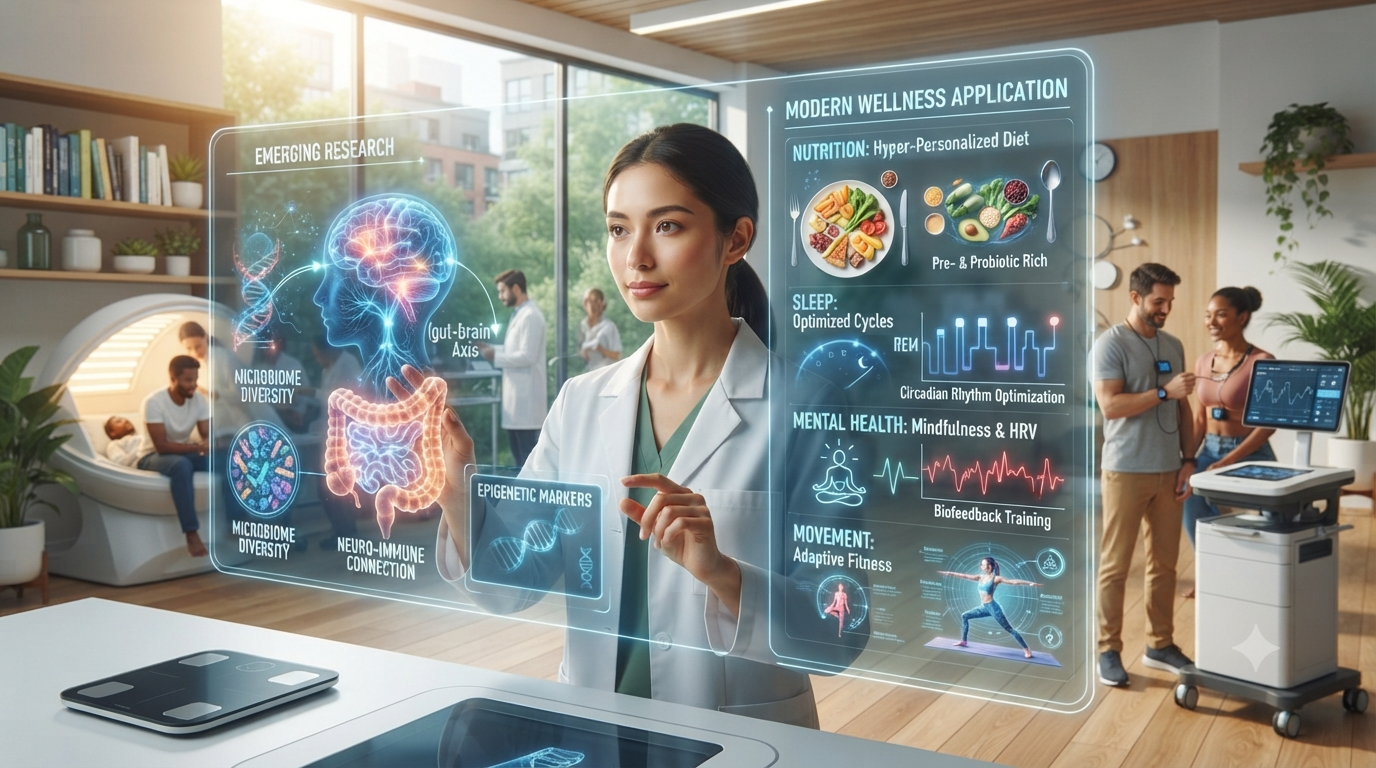
The frontier of health research is expanding in every direction. We are learning to see the body not as a collection of separate systems, but as an interconnected whole—where the microbiome influences the brain, the mitochondria influence metabolism, and the nervous system influences everything.
The most encouraging aspect of this research is its growing precision. The era of one-size-fits-all health advice is ending. In its place, a more nuanced understanding is emerging: that our genetics, our environments, our life stages, and our individual biologies shape what we need to thrive.
The trends of 2026 point toward a future where wellness is more personalized, more evidence-based, and—perhaps most importantly—more human. The backlash against over-optimization, the rise of collective wellness experiences, and the reframing of aging as functional longevity all suggest a culture recalibrating toward what matters: feeling good, connecting with others, and living well for as long as possible.
The science will continue to evolve. New discoveries will challenge old assumptions. But the fundamentals remain constant: movement, nourishment, sleep, connection, and purpose. The research is simply giving us better tools to understand and optimize them.
Imp. Note:This article is for informational purposes only and is not a substitute for professional medical advice, diagnosis, or treatment. Always seek the guidance of your physician or another qualified health provider with any questions you may have regarding a medical condition or before making changes to your diet, exercise routine, supplements, or medications. The research findings described in this article are based on studies that may be preliminary, preclinical, or subject to further validation. Do not use the information here as a basis for self-diagnosis or self-treatment. If you have concerns about your health, consult a healthcare professional for personalized assessment and guidance.