





There is a quiet assumption many of us carry: that aging is something that happens to us. A slow decline we cannot control, a process that unfolds on its own schedule. But the science tells a different story.
Aging is not a passive fate. It is, to a remarkable degree, shaped by the choices you make every single day. Not in a dramatic, life-overhaul sense, but in the small, repeated habits that accumulate over decades. What you eat for lunch. Whether you take the stairs. Who you call on a Tuesday evening.
The evidence is striking. A study of over 26,000 adults aged 64 and older found that those with a healthy lifestyle had 117% higher odds of healthy aging—defined as surviving to age 80 without developing major chronic diseases—compared to those with unhealthy habits . Even among centenarians, healthier lifestyles were associated with meaningful survival gains .
This is not about chasing immortality. It is about something more important: healthspan. The years you live in good health, with energy, independence, and a clear mind. Globally, people spend nearly ten years in poor health before they die . That gap—between lifespan and healthspan—is what your daily habits can help close.
What Healthy Aging Actually Means
Before we look at the habits themselves, let us define the goal. Healthy aging is not merely the absence of disease. It is the ability to maintain physical function, cognitive sharpness, and emotional wellbeing as the years pass.
The World Health Organization frames this around intrinsic capacity—the composite of your physical and mental abilities—and functional ability—what you can actually do with those abilities in your environment . Can you climb stairs? Carry groceries? Remember names? Engage with people you love?
A groundbreaking UK study defined successful aging as being alive at 60 and beyond, with no history of coronary artery disease, cancer, stroke, or diabetes, and with good cognitive, physical, respiratory, and cardiovascular function . The researchers found that four simple behaviors—regular physical activity, eating fruits and vegetables daily, moderate alcohol consumption, and never smoking—explained up to 47% of the population attributable risk for successful aging .
In other words, nearly half of what determines whether you age well is within your control. Each additional healthy behavior increased the odds of successful aging by 33% .
Habit One: Move Your Body, Every Single Day
If there is one recommendation that appears in every healthy aging study, it is this: move. Physical activity is the closest thing we have to a fountain of youth.
Dr. Paul Takahashi of Mayo Clinic calls physical activity his “number one recommendation” for healthy aging, because it maintains strength, balance, and mobility—the very abilities that keep older adults independent . The best exercise, he notes, is the one you enjoy and will stick with. Water aerobics, pickleball, or crawling through the garden to pull weeds all count .
But the type of movement matters. Balance training is just as important as walking, yet often overlooked. Exercises like tai chi or simply balancing on one foot can prevent falls—a leading cause of injury and loss of independence among older adults . More than one in four adults aged 65 and older falls each year, and about 20% of those tumbles result in a broken bone or head injury .
Strength training protects against the slow erosion of muscle mass that begins in midlife. Research on adults older than 55 found that muscle mass was a better predictor of longevity than body weight or BMI . Resistance bands, bodyweight exercises, or light weights a few times a week can make a profound difference.
And the benefits extend beyond the body. A 2019 study found that 77% of people reported feeling physically stronger after regular yoga practice, which also supports balance, flexibility, and mobility . Yoga’s combination of gentle movement, breathing, and mindfulness has been shown to reduce stress, anxiety, and even symptoms of depression .
Table 1: The Four Pillars of Movement for Healthy Aging
Habit Two: Eat for Your Future Self
The food you eat today sends signals to your body about how to age tomorrow.
The evidence strongly supports a Mediterranean-style pattern: abundant vegetables, fruits, whole grains, legumes, fish, and nuts, with limited red meat and processed foods . A study of over 21,000 participants found that those who closely followed this pattern had a significantly lower risk of sudden cardiac death .
But the benefits go beyond the heart. A study of nearly 1,000 older adults found that eating green leafy vegetables—spinach, kale, collards—was significantly associated with slower cognitive decline over five years . The brain, it turns out, is nourished by the same foods that protect the heart.
The gut plays a central role. Your large intestine is home to trillions of bacteria that help support digestion and keep you alive. Eating meals rich in fruits, vegetables, and whole grains ensures these bacteria are well-nourished and working to prevent chronic inflammation—a driver of many age-related diseases .
Dr. M. Elizabeth Swenor of Henry Ford Health emphasizes hydration as a foundational habit. She advises patients to divide their weight in half and drink that many ounces of water daily—a 180-pound person would aim for 90 ounces . From brain to stomach, cells throughout the body need water to function.
Table 2: Foods That Support Healthy Aging
A study from the German Center for Neurodegenerative Diseases found that a “successful aging index” combining high plant-based food intake, regular physical activity, and higher education was associated with better cognitive and motor performance in older adults . The food you eat is not just fuel; it is information that shapes how your brain and body age.
Habit Three: Stay Connected to Others
Here is a finding that surprises many people: social connection is not a luxury. It is a biological necessity for healthy aging.
“Isolation is the new smoking,” says Dr. Takahashi of Mayo Clinic . Social isolation increases the risk of heart disease and contributes to depression and anxiety. For older adults especially, a big part of a healthy life is who you are with .
The evidence supports this. A study of 12,862 older adults followed for 11 years found that frequent social activities were associated with 2% to 5% lower risk of frailty . The associations were particularly evident among women. Another study found that social isolation was a key contributor to functional decline and cognitive aging .
Staying connected does not require a large social circle. It can be as simple as picking up the phone for a chat, inviting a friend to lunch, volunteering, or joining a group you enjoy—a book club, a walking group, a church community . If loneliness feels like a problem, talking with a healthcare provider can help you find strategies to connect .
The protective effects of social connection extend to the brain. Research into participatory arts—music, theater, creative writing—shows measurable improvements in quality of life, cognition, and memory . A hobby is not just a pleasant way to pass time; it is an active investment in a sharper, more resilient mind.
Habit Four: Protect Your Sleep
Sleep is when your body does its most important repair work. While you rest, your brain clears out waste, including damaged and worn-out cells . Poor sleep quality in adults 65 and older is linked to difficulty with problem-solving and concentration, and has been associated with higher dementia risk and worsening depression .
Dr. Swenor recommends aiming for 8 hours of sleep every day . This is not a suggestion to take lightly. Quality sleep supports memory consolidation, immune function, and emotional regulation—all of which decline with age when sleep is compromised.
The relationship between sleep and aging is bidirectional. Poor sleep accelerates biological aging, and aging itself can disrupt sleep patterns. Protecting your sleep through consistent schedules, a dark and cool bedroom, and limiting screens before bed is a powerful act of preventive care.
Habit Five: Engage Your Mind and Find Purpose
The brain, like the body, thrives on challenge. But “keeping your brain active” means more than crossword puzzles—though those can help .
Dr. Takahashi emphasizes purpose as a core pillar of healthy aging. “We have to have a sense of purpose, no matter how small,” he says. “If you don’t wake up thinking, ‘I need to do this thing today,’ life can be more challenging” .
People with a sense of purpose each day often have better physical health, reduced risk of chronic disease, better sleep, and higher life satisfaction . Purpose can come from many sources: caring for grandchildren, volunteering, part-time work, pursuing a hobby, or even feeding a beloved cat .
The University of Florida Health emphasizes that keeping the brain active requires novelty. It is easy to fall into routines where much of the day operates on autopilot. Challenging your mind with new experiences, skills, and forms of learning—reading, traveling, solving puzzles, engaging in meaningful conversations—helps stimulate brain function and promote cognitive resilience .
Table 3: The Many Faces of Purpose and Engagement
The Power of Combining Habits
These habits do not operate in isolation. When combined, their effects multiply.
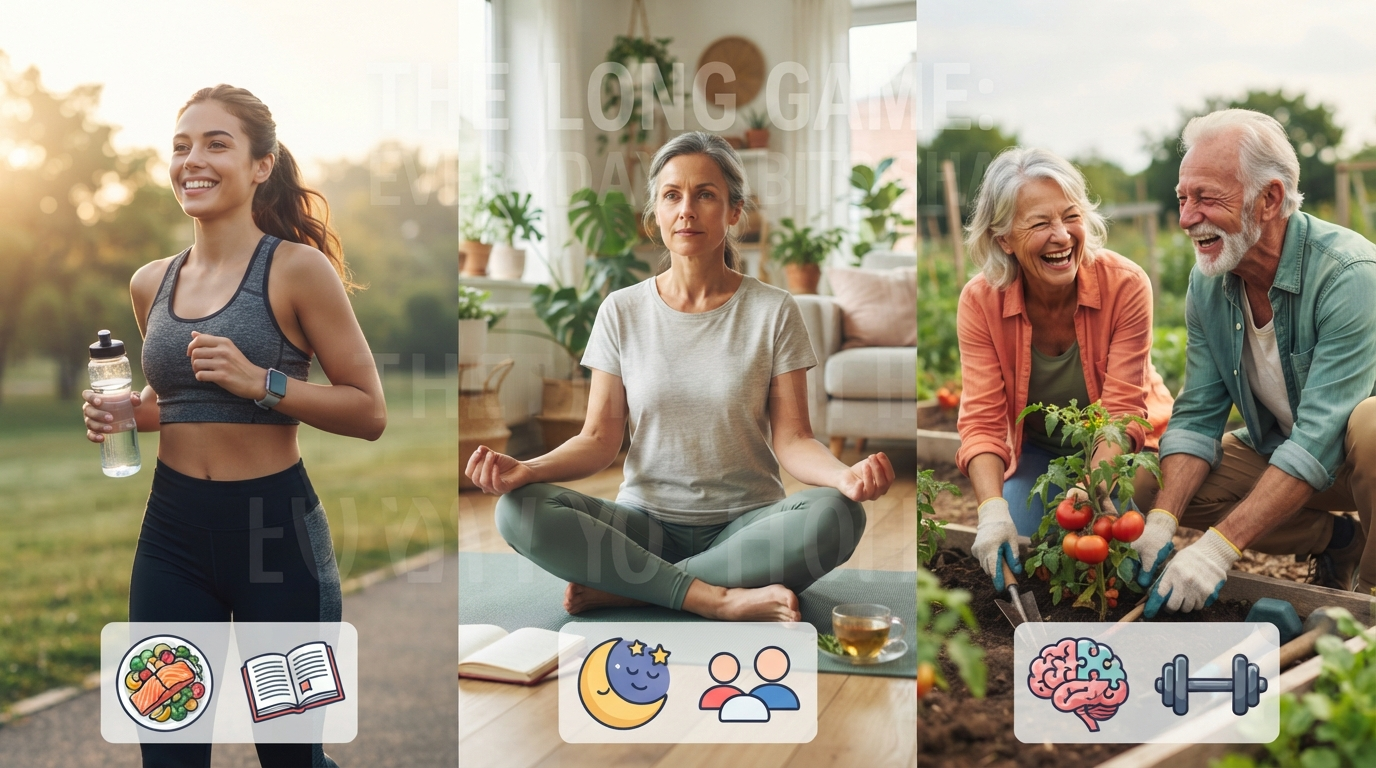
Mayo Clinic suggests blending physical activity, connection, and purpose into meaningful activities: signing up for group exercise classes, starting a community garden with a neighbor, planning a family trip, organizing a neighborhood cleanup, joining a woodworking club, or volunteering at a local farmer’s market . These activities check multiple boxes at once—movement, social connection, and a sense of purpose.
The UK Biobank study found that a healthy lifestyle was associated with higher odds of healthy aging through the regulation of specific circulating proteins involved in immune-inflammatory responses and lipid metabolism . This suggests that the benefits of good habits are not just statistical—they are biological, written into the very proteins circulating in your blood.
A study from China Kadoorie Biobank found that participants with favorable lifestyles gained 3.0 to 5.7 years of total life expectancy and 4.0 to 5.8 years of cardiovascular disease-free life expectancy compared to those with unfavorable lifestyles . Notably, participants with high genetic risk benefited most from favorable lifestyles, gaining 5.9 to 6.2 additional years . Your genes are not your destiny.
Frequently Asked Questions
Is it too late to start healthy habits if I am already in my 60s or 70s?
No. The research is clear that it is never too late. A study of centenarians found that healthier lifestyles were associated with meaningful survival gains even at extreme old age . The Japanese Collaborative Cohort Study found benefits from healthy lifestyle factors even among participants with major comorbidities at each life stage from middle age onward .
What is the single most important habit for healthy aging?
If forced to choose one, physical activity has the broadest and most powerful effects. But the real answer is that the habits work together. A composite score of lifestyle factors is more predictive of healthy aging than any single behavior . Movement, diet, sleep, social connection, and purpose reinforce one another.
How much exercise do I actually need?
For aerobic activity, aim for at least 150 minutes of moderate-intensity activity per week. But even small amounts help. A study of adults 40 and older found that people who took 8,000 steps or more per day had a significantly lower risk of death from any cause compared to those who took only 4,000 steps . Start where you are and build gradually.
Can I really prevent dementia through lifestyle?
While no lifestyle can guarantee prevention, the most convincing evidence for reducing dementia risk relates to the basic foundations of a healthy lifestyle: aerobic exercise, a plant-based diet, and quality sleep. Aerobic exercise helps reduce the buildup of toxic proteins in the brain and improves blood flow. A plant-based diet can manage inflammation. Quality sleep helps the brain clear out harmful proteins .
What role does alcohol play in healthy aging?
Moderate alcohol consumption—defined as non-harmful drinking—was one of the four behaviors associated with successful aging in the Whitehall II study . However, the evidence on alcohol is complex, and many health organizations now emphasize that less is better. A study using biological aging markers found that non-harmful drinking was associated with decelerated aging . If you drink, moderation is key. If you do not drink, there is no reason to start.
How do I stay motivated to maintain these habits?
Motivation is fickle. Systems are more reliable. Find activities you genuinely enjoy—if you hate running, do not run. Schedule movement like an appointment. Find a walking buddy or join a group. Track your progress not just on the scale, but in how you feel and what your body can do. Purpose helps: when you have a reason to get up and move, the habits become easier to sustain .
Helpful Websites and Resources
- World Health Organization (WHO) – Healthy Ageing: Global guidance, data, and resources on the Decade of Healthy Ageing. (who.int)
- Mayo Clinic – Healthy Aging: Practical tips from geriatric experts on thriving as you age. (mayoclinic.org)
- Harvard Health Publishing – Healthy Aging and Longevity: Research-backed articles on habits that support long-term wellness. (health.harvard.edu)
- National Institute on Aging (NIA) – Healthy Aging: Comprehensive resources on physical, cognitive, and social health. (nia.nih.gov)
- Centers for Disease Control and Prevention (CDC) – Healthy Aging: Data, prevention resources, and tips for older adults. (cdc.gov)
A Conclusion That Begins Today
The most encouraging finding in the science of aging is also the simplest: you are not a passenger in this process. You are, to a remarkable degree, the author.
The habits that matter most are not exotic. They do not require expensive supplements, cutting-edge technology, or a complete life overhaul. They are the things your grandmother might have told you: move your body, eat your vegetables, get some sleep, stay connected to people you love, and find something worth waking up for.
What makes them powerful is not their complexity but their consistency. Small investments, made routinely over months and years, compound in ways that are hard to appreciate in the moment but unmistakable decades later .
The years will pass regardless. The question is what kind of years they will be. Start today. Take a walk. Call a friend. Eat a vegetable. Go to bed on time. Find one small thing that gives you purpose.
Your future self is already waiting. And they will thank you for what you do now.
Imp. Note: This article is for informational purposes only and is not a substitute for professional medical advice, diagnosis, or treatment. Always seek the guidance of your physician or another qualified health provider with any questions you may have regarding a medical condition or before making changes to your diet, exercise routine, or lifestyle. If you have concerns about your health or risk of chronic disease, consult a healthcare professional for personalized assessment and guidance.