






A Note Before We Begin: Weight loss is deeply personal, and the journey looks different for everyone. This guide draws from reputable medical sources to offer practical, sustainable strategies. It is not a substitute for professional medical advice. Please consult your healthcare provider before starting any weight loss program, especially if you have underlying health conditions.
Introduction: The Quiet Beginning
There is a moment—quiet, unremarkable—when something shifts. Maybe it’s the way your favorite jeans fit. Maybe it’s a number on a lab report. Maybe it’s simply a feeling: I’m ready.
If you’re reading this, you’ve likely arrived at that moment. And here’s the first thing you should know: you don’t need to overhaul your entire life today. You don’t need to punish your body. You don’t need to follow a diet named after someone else’s philosophy.
What you need is a beginning. And beginnings, as it turns out, can be beautifully simple.
In 2022, the World Health Organization reported that 43% of adults worldwide were overweight, and 16% were living with obesity . If you’re among them, you are not alone—and you are not broken. Weight management is complex, influenced by genetics, environment, stress, sleep, medications, and more . It is not a simple matter of willpower.
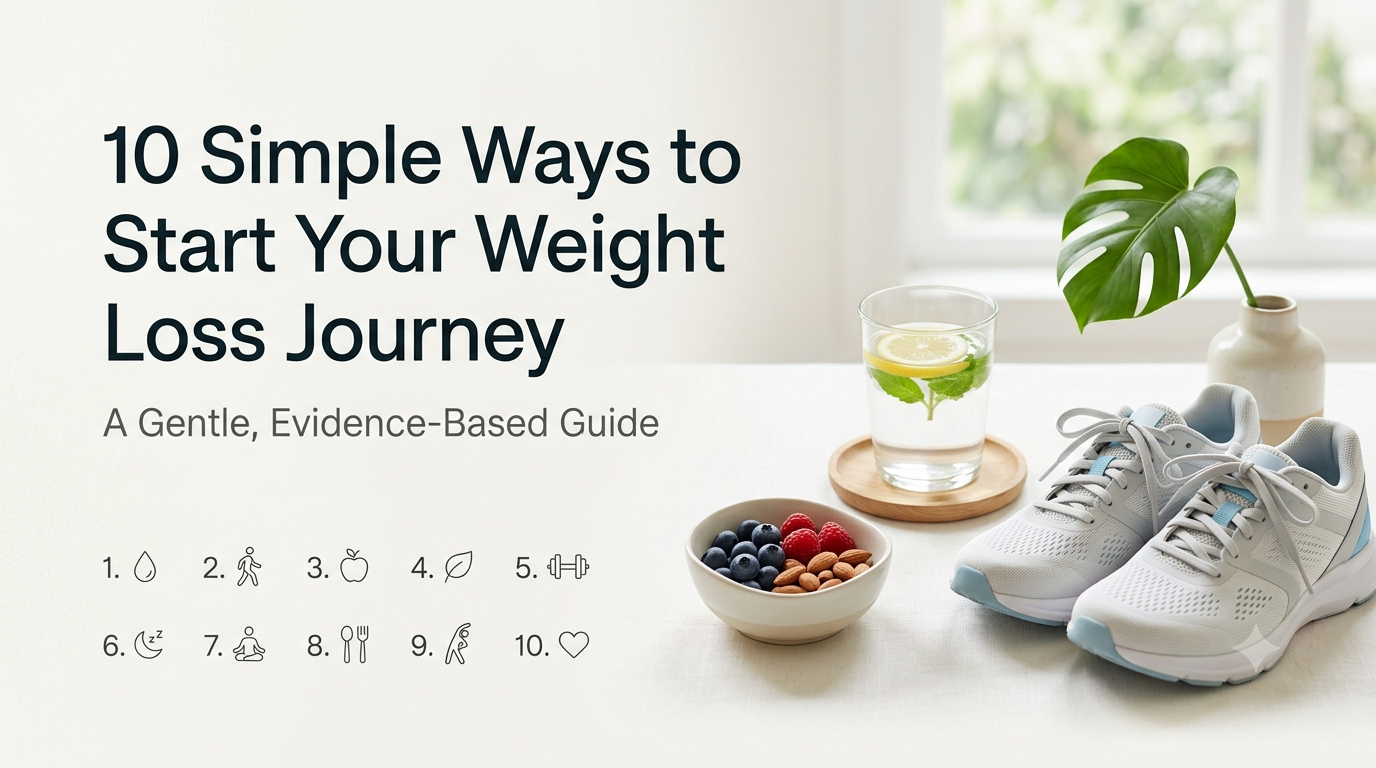
This guide offers ten simple, evidence-based ways to start. No shame. No extreme measures. Just gentle, sustainable steps toward a healthier you.
1. Understand Your “Why” (And Write It Down)
Before you change what you eat or how you move, pause. Ask yourself: Why do I want this?
The CDC recommends starting your weight loss journey by understanding your motivation . Maybe you want to play with your grandchildren without getting winded. Maybe you want to reduce your risk of type 2 diabetes. Maybe you simply want to feel more comfortable in your own skin.
Write your reasons down. Place them somewhere you’ll see daily—your bathroom mirror, your phone lock screen, your journal. When motivation wavers (and it will), these words will remind you of the deeper purpose behind the daily choices.
Why this matters: Research shows that people who identify specific, personally meaningful reasons for losing weight are more likely to stay committed .
2. Set a Specific Goal (Not a Vague Wish)
“I want to lose weight” is a wish. “I want to lose one pound per week” is a goal.
The American Diabetes Association emphasizes that effective goals are specific, measurable, and achievable . Instead of aiming for an abstract number, try:
- “I will lose 5% of my body weight over the next six months.”
- “I will walk for 15 minutes, three days a week, for the first month.”
Why 5%? Because research consistently shows that losing just 5–10% of your starting weight can significantly improve blood pressure, cholesterol, and blood sugar levels . For a 200-pound person, that’s just 10–20 pounds—a modest, achievable target that can transform your health.
| Starting Weight | 5% Loss | 10% Loss | Health Benefits Begin |
|---|---|---|---|
| 150 lbs | 7.5 lbs | 15 lbs | ✓ |
| 200 lbs | 10 lbs | 20 lbs | ✓ |
| 250 lbs | 12.5 lbs | 25 lbs | ✓ |
| 300 lbs | 15 lbs | 30 lbs | ✓ |
3. Track Where You Are (Without Judgment)
You cannot change what you do not notice. The CDC recommends tracking your current habits—nutrition, physical activity, sleep, and stress—for a few days before making changes .
This isn’t about judging yourself. It’s about gathering information. A food journal, for example, reveals patterns you might not otherwise see: the afternoon snack that happens out of boredom, the late-night eating triggered by stress, the liquid calories that add up silently.
A simple tracking practice:
- Write down everything you eat and drink for three days
- Note the time, the food, and how you felt afterward
- Track your steps or activity minutes
- Note your sleep hours
One study found that women who used a food journal lost an average of 6 pounds more than those who did not track their eating .
4. Start with One Small Change
The NHS advises starting with one small thing. Once that becomes a habit, choose the next thing .
This is perhaps the most liberating principle in weight management: you don’t have to do everything at once.
Choose one change from this list:
- Drink water instead of sugary soda with dinner
- Add a vegetable to your lunch
- Take a 10-minute walk after your evening meal
- Eat breakfast at home instead of grabbing fast food
The Office on Women’s Health echoes this: “Pick one small healthy eating goal and work on that until you can reach that goal most of the time” . Only then should you add another.
Why this works: Small changes feel manageable. They build confidence. And they compound over time into significant results.
5. Build a Better Plate (The Simple Math of Balanced Eating)
You don’t need to count every calorie or eliminate entire food groups. You need a simple visual framework.
The American Diabetes Association recommends the Diabetes Plate Method: fill half your plate with non-starchy vegetables, one quarter with lean protein, and one quarter with high-fiber carbohydrates . The University of California, Berkeley offers a similar “Healthy Plate” model .
| Plate Section | What Goes There | Examples |
|---|---|---|
| ½ Plate | Non-Starchy Vegetables | Broccoli, spinach, peppers, salad greens, carrots, tomatoes |
| ¼ Plate | Lean Protein | Chicken, fish, tofu, beans, lentils, lean beef |
| ¼ Plate | Starches & Grains | Brown rice, quinoa, whole-wheat bread, sweet potato |
This method naturally controls portions and ensures you’re getting fiber, protein, and nutrients—without obsessive measuring.
6. Move Your Body in Ways You Actually Enjoy
Exercise is not punishment. It is a celebration of what your body can do.
The NHS recommends finding activities you enjoy: walking, swimming, cycling, dancing, wheeling—anything that gets you moving . The CDC suggests aiming for at least 150 minutes of moderate-intensity activity per week, which breaks down to about 30 minutes, five days a week .
But here’s the crucial part: start smaller if you need to. A 10-minute walk is infinitely better than no walk. The National Institutes of Health’s Diabetes Prevention Program found that walking 30 minutes daily, five days a week was effective—but many participants started with just 10 minutes .
Adding strength training: The NHS also recommends muscle-strengthening activities like lifting weights, yoga, or heavy gardening at least twice a week . Muscle burns more calories at rest, making it a worthy investment.
7. Prioritize Sleep (The Underrated Weight Loss Tool)
You cannot out-diet poor sleep.
The NHS explicitly states that poor sleep and high stress can lead to weight gain . The CDC includes sleep as one of the five key components of healthy weight management . When you’re sleep-deprived, your body produces more ghrelin (the hunger hormone) and less leptin (the fullness hormone). You crave sugar and refined carbohydrates. Your metabolism slows.
Aim for 7–9 hours of sleep per night. Establish a regular bedtime. Avoid caffeine in the afternoon and evening. Turn off screens at least 30 minutes before bed .
Stress management matters too. Chronic stress elevates cortisol, which can increase appetite and promote fat storage, particularly around the abdomen. Find what calms you—a walk, deep breathing, music, prayer, time in nature—and protect that time.
8. Practice Mindful Eating (Slow Down, Notice, Enjoy)
How you eat matters as much as what you eat.
The NHS advises avoiding eating while distracted—no working, watching TV, or scrolling on your phone . When you eat mindlessly, you consume more without noticing.
Mindful eating in practice:
- Sit at a table
- Put your fork down between bites
- Chew slowly
- Notice the taste, texture, and aroma
- Rate your hunger before and after eating (1 = starving, 10 = stuffed; aim for 4–6)
This practice transforms meals from a mindless activity into a nourishing experience. It also helps you recognize when you’re full—something many of us have forgotten how to feel.
9. Plan for Setbacks (Because They Will Happen)
You will have days when you eat more than you intended. Days when you skip your walk. Days when the scale doesn’t move.
This is not failure. This is being human.
The American Diabetes Association offers a powerful reframe: “Make sure a slip doesn’t turn into a slide” . One cookie does not ruin your progress. One missed workout does not undo weeks of effort. What matters is what you do next.
The kind self-talk approach: Instead of saying “I failed,” try “That didn’t go as planned, and that’s okay” . Instead of “I’ll start over Monday,” try “What can I do right now to get back on track?”
Self-compassion is not weakness. It is strategy. People who practice self-kindness during weight loss are more likely to persist than those who beat themselves up.
10. Seek Support (You Don’t Have to Do This Alone)
The NHS is clear: “You don’t have to do it alone” . Reaching out to a friend, family member, doctor, dietitian, or support group can help you stay motivated and confident.
Support can look like:
- A walking partner who holds you accountable
- A healthcare provider who monitors your progress
- A registered dietitian who helps you navigate nutrition
- An online community of people on similar journeys
- A therapist who helps you address emotional eating patterns
The National Institutes of Health emphasizes that effective weight loss programs include ongoing support, whether individual or group, in-person or virtual .
Helpful Websites (Fact-Checked and Trustworthy)
A 2024 data-mining study analyzed 432 Google searches for weight loss and identified the most trustworthy non-advertising websites based on accuracy statements, author credentials, and reputation scores . These sites consistently provided evidence-based information:
| Website | Category | Reputation Score | Why It’s Trustworthy |
|---|---|---|---|
| healthline.com | Health | 96/100 | Fact-checked, written by healthcare professionals |
| mayoclinic.org | Health | 100/100 | Mayo Clinic Staff authorship, evidence-based |
| webmd.com | Health | 96/100 | Physician-reviewed content |
| verywellfit.com | Nutrition & Diet | 88/100 | Nutrition-focused, fact-checked |
| womenshealthmag.com | Women’s Health | 88/100 | Author credentials and fact-checking |
Additional government and institutional resources:
- CDC Healthy Weight (cdc.gov/healthy-weight-growth): Practical steps from the Centers for Disease Control
- NHS Weight Loss Guide (nhsinform.scot): Clear, compassionate advice from the UK’s National Health Service
- NIDDK Weight Management (niddk.nih.gov): Evidence-based information from the National Institutes of Health
Caution: Be wary of websites that promise rapid results, sell supplements, or lack author credentials. The study found that “Personal Pages and Blogs” often lack transparency about authorship and accuracy .
Frequently Asked Questions
Q: How fast should I lose weight?
A: Most health organizations recommend losing 1–2 pounds per week . This pace is more likely to be fat loss rather than water or muscle loss, and it’s easier to sustain long-term. That said, some research suggests that faster initial weight loss may work for some people—just ensure you’re working with a healthcare provider to meet nutritional needs .
Q: Do I need to cut out carbohydrates entirely?
A: No. Carbohydrates are your body’s primary energy source. The key is quality. Cut back on simple carbohydrates (cookies, candy, sugary drinks) and keep complex carbohydrates (whole grains, beans, fruits) on your plate .
Q: Is skipping breakfast bad for weight loss?
A: Not necessarily. While eating a healthy breakfast can help manage hunger later in the day, scientific studies have not shown that skipping breakfast directly causes weight gain . Listen to your body. If you’re not hungry in the morning, don’t force it—but avoid compensating with a massive lunch.
Q: Can I be overweight and healthy?
A: Some people are overweight with healthy blood pressure, cholesterol, and blood sugar levels. However, carrying excess weight increases the risk of developing health problems over time, particularly heart disease and diabetes . Healthy eating and regular activity are beneficial regardless of your weight.
Q: Do weight loss pills work?
A: Prescription weight loss medications can help some people, but they work best alongside diet and lifestyle changes. Without those changes, weight is typically regained when the medication stops. Medications also carry side effects and costs . Talk to your doctor if you’re interested.
Q: What if I have an off day and eat everything in sight?
A: It happens. One off day does not define your journey. The American Diabetes Association’s advice is simple: get back on track as quickly as possible. Think about what triggered the slip and how you might handle it differently next time . Progress, not perfection.
A Final Word: Progress, Not Perfection
Weight loss is not a linear journey. It is not a test of willpower. It is not a moral failing if the scale doesn’t cooperate.
It is a practice. A series of small decisions, made repeatedly, that gradually reshape your habits, your health, and your relationship with your body.
The NHS offers perhaps the gentlest and most important advice of all: “Be realistic and kind to yourself. Expect ups and downs and remember, everyone has off days. What matters is getting back on track without feeling guilty” .
You don’t need to be perfect. You don’t need to lose 30 pounds by next month. You don’t need to follow the latest diet trend or buy expensive supplements.
You need to start. Small. Gentle. Kind.
And then you need to keep going—one simple choice at a time.
Imp. Note: This article is for informational purposes only and does not constitute medical advice. Always consult with a qualified healthcare professional before beginning any weight loss program.